100+ MCQ Class 9 Science Term 1 MCQs Is Matter Around Us Pure?

100+ Mcq uploaded Class 9 Science Term 1 MCQs Is Matter Around Us Pure?
Q.1 Which of the following is not obtained as a component during the isolation of components by fractional distillation of air?
(a) Carbon dioxide
(b) Argon
(c) Carbon Monoxide
(d) Oxygen
Q.2. For which of the following mixtures, the same method of separation can be followed as a mixture of naphthalene and sand?
(a) Iron fillings and camphor
(b) Iodine in carbon tetrachloride
(c) Sulphur in carbon disulphide
(d) Camphor and ammonium chloride
Q.3. Identify the odd one out.
(a) Fog
(b) Mist
(c) Smoke
(d) Cloud
Q.4. Which of the following is not the common property of smoke and fog?
(a) Physical state of dispersed phase
(b) Physical state of dispersion medium
(c) Smoke is an aerosol.
(d) Smoke is a heterogeneous mixture.
Q.5. The elemental gas present in acid rain.
(a) Sulphur dioxide
(b) Carbon monoxide
(c) Nitrogen
(d) Oxygen
Q.6. Which of the following mixtures has two components and both are compounds ?
(a) Tincture of iodine
(b) Aqueous solution of common salt
(c) Brine Solution
(d) All of these
Q.7. Lemonade is prepared by a kid at home. Which component of the lemonade should be a pure substance?
(a) Water
(b) Sugar
(c) Salt
(d) Lemon extract
Q.8. Which of the following is the correct representation of a mixture of an element and a compound?
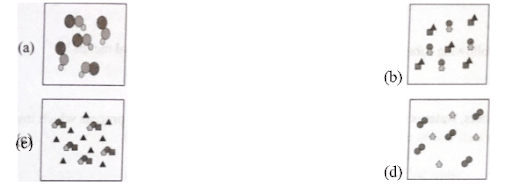
Q.9. Identify the statements which comply with bromine dissolved in carbon tetrachloride?
(a) It is a solid-liquid homogeneous mixture.
(b) After separation, bromine cannot be broken down into simpler substances.
(c) Carbon tetrachloride has the properties of carbon and chlorine.
(d) Bromine and carbon tetrachloride can be separated by a separating funnel.
Q.10. Which of the following substances undergoes change in state when taken from a cold place (temperature > 273 K) to a place where the average room temperature is 40°?
(a) Sulphur
(b) Water vapour
(c) Mercury
(d) Gallium
Q.11. Which of the following substances, on sufficient cooling, produces a solid which undergoes sublimation under normal conditions?
(a) Water vapour
(b) Ammonia
(c) Carbon dioxide
(d) Chlorine
Q.12. The constituents of which substances can be separated only by chemical means?
(a) Brine solution
(b) Alumina
(c) Milk
(d) Gold amalgam
Q.13. In a medical shop, I found four bottles labelled as given in the options. Which bottle is considered to be a heterogeneous mixture in which the particles are not visible to the naked eye?
(a) Noxafil oral suspension
(b) Hydrogen peroxide
(c) Aristozyme digestive syrup
(d) Tincture of iodine
Q.14. Which liquids used for medical purposes are considered as a sol?
(a) Milk of magnesia
(b) Surgical spirit
(c) Hand sanitiser
(d) Dettol
Q.15. A solid can be recovered from a mixture by the method of crystallisation. Which among the following statements comply with the above mixture?
(i) The mixture is homogeneous.
(ii) The mixture taken must be a saturated solution.
(iii) The solid can also be recovered by the method of centrifugation.
(iv) The mixture does not contain any other impurities along with the solid.
(a) i, iii and iv
(b) i and ii
(c) ii and iv
(d) Only i
Answer Key for Class 9 Science Chapter 2 Is Matter Around Us Pure MCQs
| Q. | Ans | Q. | Ans |
| 1 | (c) | 9 | (b) |
| 2 | (a) | 10 | (d) |
| 3 | (c) | 11 | (c) |
| 4 | (a) | 12 | (b) |
| 5 | (a) | 13 | (c) |
| 6 | (c) | 14 | (a) |
| 7 | (b) | 15 | (b) |
| 8 | (c) |
1.) More than one kind of pure form of matter combines forming………..
a) Texture
b) Solution
c) Mixture
d) Component
ANS-Mixture
2.) Dissolved sodium chloride can be separated from water by…………………
a) Chemical process
b) Physical process
c) Chemical process of extraction
d) Physical process of evaporation
ANS-Physical process of evaporation
3.) Non uniform compositions of solutions called………….. solutions.
a) Mixture
b) Texture
c) Homogenous
d) Heterogeneous
ANS-Heterogeneous
4.) Uniform compositions of solutions called………… solutions.
a) Mixture
b) Texture
c) Homogenous
d) Heterogeneous
ANS-Homogenous
5.) Homogenous solution may separated by……………….
a) Chemical process
b) Physical process
c) filtration
d) Physical process of evaporation
ANS- Chemical process
6.) Mixture of two or more metals , or metals and non-metals called as…………
a) Alloy
b) Solution
c) Mixture
d) Metallic mixture
ANS-Alloy
7.) Alloy cannot be separated by……………..method
a) Chemical
b) Evaporation
c) Extraction
d) Physical
ANS-Physical
8.) Brass is mixture of………….. and……….. .
a) Zinc, carbon
b) Zinc, Mg
c) Zinc, Co
d) Zinc, Copper
ANS-Zinc, Copper
9.) Zinc and Copper get mixed by forming……….
a) Steel
b) Brass
c) Gold
d) Zinc carbon mixture
ANS-Brass
10.) Component present in large amount in solution called………….
a) Solute
b) Sugar
c) Solvent
d) Mixture
ANS-Solvent
11.) The component of solution that dissolved in solvent called……………
a) Solute
b) Sugar
c) Solvent
d) Mixture
ANS-Solute
12.) A component present in lesser quantity in solution called………..
a) Solute
b) Sugar
c) Solvent
d) Mixture
ANS-Solute
13.) A component present in more quantity in solution called……………
a) Solute
b) Sugar
c) Solvent
d) Mixture
ANS-Solvent
14.) Sugar in water..in that case sugar is …………..
a) Solute
b) Small particles
c) Solvent
d) Mixture
ANS-Solute
15.) Air is ………………….. mixture.
a) Heterogeneous
b) Gas
c) Solid
d) Homogenous
ANS- Homogenous
16.) if the solute particle size is smaller than …… then it cannot seen by naked eyes.
a) 1m
b) 1cm
c) 1mm
d) 1nm
ANS-1nm
17.) When no more solute can be dissolved in solution at given temperature is called………. Solution.
a) Homogenous
b) Heterogeneous
c) Saturated
d) Unsaturated
ANS-Saturated
18.) The amount of the solute present in the saturated solution at this temperature is called its………………….
a) Unsaturation
b) Diffusion
c) Collusion
d) Solubility
ANS-Solubility
19.) If the amount of solute contained in the solution is less than the saturation level…it called as……………
a) Saturated solution
b) Unsaturated solution
c) Homogenous solution
d) Heterogeneous solution
ANS-Unsaturated solution
20.) The concentration of solution is the depend on amount of …………………. Present in given solution.
a) Solvent
b) Solution
c) Pericles
d) Solute
ANS-Solute
21.) Mass of solute divided by mass of solution multiply by 100 then we get?
a) Solution
b) Mass
c) Mass percentage of solution
d) Volume percentage
ANS-Mass percentage of solution
22.) Mass of solute divided by volume of solution multiply by 100 then we get?
a) Solution
b) Mass
c) Mass percentage of solution
d) Mass by Volume percentage of solution
ANS- Mass byVolume percentage of solution
23.) If the solution is 400 ml and solvent is 300ml so what is percentage of solute?
a) 30
b) 40
c) 45
d) 25
ANS-25
24.) Solids are disperse in liquids called……
a) Diffusion
b) Dissolution
c) Collusion
d) Suspension
ANS-Suspension
25.) Suspension is ……………… mixture.
a) Saturated
b) Unsaturated
c) Homogenous
d) Heterogeneous
ANS-Heterogeneous
26.) Mixture of water and milk shows……………….. effect.
a) Solubility
b) Diffusion
c) Tyndall
d) Brightening
ANS-Tyndall
27.) Colloid is ………… mixture.
a) Saturated
b) Unsaturated
c) Homogenous
d) Heterogeneous
ANS-Heterogeneous
28.) …………….. particles are scattered a beam of light passing through it and make its path visible.
a) Solute
b) Solvent
c) Colloidal
d) None of the above
ANS-Colloidal
29.) Foam is the example of…………
a) Scattering light
b) Colloids
c) Saturated solution
d) Unsaturated solutions
ANS-Colloids
30.) We can separate the volatile component from its non volatile solute by the method of………….
a) Extraction
b) Separation
c) Filtration
d) Evaporation
ANS- Evaporation
31.) Solid particle are not soluble in solution. That can be separated by the………
a) Extraction
b) Separation
c) Filtration
d) Evaporation
ANS- Filtration
32.) Solid particles are very small in solution which cannot separated by filtration that solution separated by ………………….
a) Dissolution
b) Collusion
c) Suspension
a) Centrifugation
ANS-Centrifugation
33.) Centrifugation do not used in………..
a) Diagnostic laboratories
b) Separate butter and cream
c) To separate water and sugar
d) Used in washing machines
ANS-To separate water and sugar
34.) Two immiscible layers can separate out in layer depending on their …………………
a) Volume
b) Surface tension
c) Density
d) Viscosity
AN-Density
35.) ……………………….solutions can separated depending upon their densities.
a) Miscible solution
b) Water
c) Immiscible
d) Colloidal
ANS-Immiscible
36) Separation of camphor and salt done by…………… method
a) Dissolution
b) Collusion
c) Sublimation
d) Suspension
ANS-Sublimation
37.) Separation of dyes and black ink using ……………………. Method.
a) Dissolution
b) Chromatographic
c) Sublimation
d) Suspension
ANS-Chromatographic
38.) ………………. Is a mixture of 2 or more colors.
a) Alloy
b) Dyes
c) Ink
d) Paints
ANS-Dyes
39.) Kroma means?
a) Dyes
b) Colors
c) Paints
d) Natural colors
ANS-Colors
40.) ……………………….. is method to separate two miscible liquids.
a) Collusion
b) Sublimation
c) Suspension
d) Distillation
ANS-Distillation
41.) Chromatographic method used to separate
a) Colors in dye
b) Drug from blood
c) Tea powder from factory
d) Drugs from blood
ANS-Tea powder from factory
42.) Two miscible liquids having boiling point less than 25K can separated by ……………..
a) Distillation
b) Sublimation
c) Suspension
d) Fractional distillation
ANS-Fractional distillation
43.) ………………………… method used for separation of petroleum products.
a) Distillation
b) Sublimation
c) Suspension
d) Fractional distillation
ANS-Fractional distillation
44.) Boiling point of oxygen.
a) -280
b) -183
c) -130
d) -220
ANS- -183
45.) Boiling point of nitrogen
a) -196
b) -183
c) -130
d) -220
ANS- -196
46.) Crystallization method is used to purify………..
a) Liquid
b) Gas
c) Solid
d) Miscible liquids
ANS-Solids
47.) ………………….. method is used to purify solid.
a) Distillation
b) Sublimation
c) Fractional distillation
a) Crystallization
ANS-Crystallization
48.) Crystal alum separated from impure samples by……………………. Method.
a) Distillation
b) Sublimation
c) Fractional distillation
d) Crystallization
ANS-Crystallization
49.) Chemical change shown in reaction called……………
a) Physical reaction
b) Chemical reaction
c) Saturated
d) Substitution reaction
ANS-Chemical reaction
50.) Two or more atoms combined together forming….
a) Element
b) Molecule
c) Atoms
d) None of the above
ANS-Molecule
| 1. (c) | 2. (b) | 3. (c) | 4. (c) | 5. (a) |
| 6. (b) | 7. (a) | 8. (a) | 9. (d) | 10. (b) |
| 11. (c) | 12. (b) | 13. (a) | 14. (d) |
1. What kind of solution is milk?(a) Suspension (b) Colloid(c) True solution (d) Alloy2. A liquid and a solid are found together in a single phase. What is this known as?(a) Solution (b) Solute(c) Solvent (d) Emulsion3. Which of the following is a homogeneous solution?(a) Muddy water(b) Bread(c) Concrete(d) A solution of sugar in water4. What kind of a colloidal solution is an emulsion?(a) Solid dispersed in solid.(b) Liquid dispersed in liquid.(c) Gas dispersed in liquid.(d) Liquid dispersed in solid.5. In which of the following does scattering of light takes place?(a) Electrolytic solutions (b) Colloidal solutions(c) Electrodialysis (d) Alcoholic solutions6. Which of the following forms a colloidal solution in water?(a) Salt (b) Glucose(c) Starch (d) Barium nitrate7. Which of the following is NOT a physical change?(a) Tearing a paper(b) Bending an iron rod(c) Freezing water into ice(d) Curdling of milk8. In which of the following is Tyndall effect observed?(a) Solution (b) Precipitate(c) Sol (d) Vapour9. How is Brownian motion caused?(a) Through temperature fluctuations within the liquid phase(b) Through attraction and repulsion between the charges on the colloidal particles(c) Through collision of molecules between the colloidal particles(d) Through pressure variations within the liquid phase10. To which of the following category does ice-cream belong?(a) Solution (b) Emulsion(c) Element (d) Suspension11. What can be observed when sunlight is passed through a colloidal solution?(a) Adsorption (b) Coagulation(c) Tyndall effect (d) Brownian motion
312. What is a sol?(a) A solid dispersed in a liquid(b) A liquid dispersed in a gas(c) A gas dispersed in a liquid(d) A gas dispersed in a solid13. In both dialysis and osmosis which particles do not pass through the semipermeable membrane?(a) Water (b) Small molecules(c) Colloids (d) All of the above14. What is the name of the process for the separation of colloidal panicles from those of crystalloids called?(a) Dialysis (b) Pyrolysis(c) Peptization (d) Photolysis15. Shaving cream produces foam. What kind of colloid is shaving cream?(a) Liquid dispersed in a gas(b) Gas dispersed in a liquid(c) Solid dispersed in a liquid(d) Solid dispersed in a gas16. What kind of solution is drinking soda?(a) Gas in liquid (b) Liquid in gas(c) Gas in gas (d) Solid in liquid17. What kind of solution is amalgam?(a) Solid in solid (b) Solid in mercury(c) Liquid in solid (d) Liquid in liquid18. Which of the following is a true solution?(a) NaClin sulphur dioxide.(b) Copper in silver.(c) Salt in petrol.(d) Mud in water.19. Which of the following is a chemical change?(a) Boiling of eggs.(b) Evaporation of water.(c) Precipitation of snow.(d) Melting of wax.20. What are the materials which contain at least two pure substances and show the properties of their constituents called?(a) A compound (b) An element(c) A mixture (d) A solution21. Which of the following is a solid-in-solid colloid?(a) Shaving cream (b) Milk of magnesia(c) Milky glass (d) Cheese22. What is a solution of iodine in carbon tetrachloride called?(a) Aqueous solution(b) Alcoholic solution(c) Non-aqueous solution(d) Tincture of iodine
423. Which of the following is a characteristic of both mixtures and compounds?(a) They contain components in fixed proportions.(b) Their properties are the same as those of their components.(c) Their weight is equal to the sum of the weights of their components.(d) Energy is given out when they are being prepared.24. What happens when salt dissolved in water is heated?(a) There is an increase in the boiling point.(b) There is no change in the boiling point.(c) There is a decrease in the boiling point.(d) All of the above25. Which of the following is NOT a compound?(a) Sugar (b) Common salt(c) Diamond (d) Plaster of Paris26. Which of the following is an example of a mixture?(a) Sugar (b) Brass(c)CO2(d)NO227. Which of the following obey the law of constant proportions in their formation?(a) Mixtures (b) Compounds(c) Elements (d) Colloids28. By which process the drugs from the blood are separated?(a) Distillation(b) Chromatography(c) Sublimation(d) Separating funnel29. How can sugar from sugar solution be separated?(a) By distillation (b) By evaporation(c) By sublimation (d) By filtration30. Which of the following processes of separating substances involves both evaporation and condensation?(a) Filtration (b) Crystallisation(c) Distillation (d) Sedimentation31. Which of the following processes is useful to collect pure water from a solution of sugar and water or salt and water?(a) Filtration (b) Evaporation(c) Distillation (d) Crystallisation32. Which of the following processes can be useful in separating the salt from a mixture of sand and salt?(a) Dissolution (b) Filtration(c) Evaporation (d) All of the above33. What is the process involved in making candy?(a) Filtration (b) Crystallisation(c) Sedimentation (d) Centrifugation534. By which method can ammonium chloride be separated from sand?(a) By hand picking (b) By filtration(c) By sublimation (d) By diffusion35. By which process can we separate camphor from ammonium chloride?(a) Filtration(b) Sublimation(c) Dissolution and evaporation(d) Distillation36. Which of the following apparatus is used to separate a mixture of immiscible liquids?(a) Centrifuge (b) Condenser(c) Separating funnel (d) Distillation flask37. What is the technique used to separate dirt particles from clothes in a washing machine?(a) Magnetic separation (b) Filtration(c) Evaporation (d) Centrifugation38. What kind of change is undergone when an electric bulb glows(a) A physical change(b) A chemical change(c) Both a physical and a chemical change(d) A permanent change39. Both cooking oil and water are liquids at room temperature. By which of the given characteristics are they differentchemically?(a) Same colour and flammability(b) Odour and inflammability(c) Solubility and similar taste(d) Odour and flammability40. What type of mixture is steel?(a) Solid-liquid heterogeneous mixture(b) Solid-solid heterogeneous mixture(c) Solid-solid homogeneous mixture(d) Pure substance41. Two substances Pand Qwhen brought together, form substance Rwith the evolution of heat. The properties of Rare different from both PandQ. What is substanceR?(a) A compound (b) An element(c) A metal (d) A mixture42. Which of the following pairs of colloidal solutions have dispersed phase as liquid and dispersing medium as gas?(a) Fog, mist (b) Butter, milk(c) Fog, smoke (d) Smoke, foam43. Which of the following is a true solution?(a) Copper in gold(b) Sulphur in water(c) Milk(d) KClin sulphur dioxide644. Identify a pure substance from the following?(a) Steel (b) Magnalium(c) Ammonia (d) Gun powder45. What is the smallest constituent of matter that retains its chemical identity?(a) Atom (b) Molecule(c) Ion (d) Radical46. Which of the following solutions shows Tyndall effect?(a) A solution of common salt(b) A solution of sodium carbonate(c) Starch solution(d) Sugar solution47. The size of a colloidal particle is(a) 110to310 cm (b) 510to710 cm (c) 810to510 cm (d) 610to810 cm 48. Which of these statements is/are true?(a) The components of a suspension can be separated by filtration.(b) The particles of a colloid can pass through a filter paper.(c) The constituents of a compound can be separated easily.(d) Both (a) and (b)49. A student added 10 12 ml ml of Conc. H SO 2 4in a test tube containing 5 6 g g of sugar crystals and warmed it gently. He noticed that white crystals slowly turned brown and became a black mass. What happened in this change?(a) H SO 2 4turned black but no change took place.(b) Sugar got charred by the action of hot. conc. H SO 2 4and a chemical change took place.(c) It is only a physical change.(d) It is an irreversible physical change.50. A dispersed phase particle in a zig-zag movement is shown below.What kind of motion is exhibited by the particle?(a) Transitional motion(b) Circular motion(c) Linear motion(d) Brownian motion
Comments
Post a Comment